Preparing for tax season doesn’t have to be a stressful scramble. Whether you are an employee, a freelancer, or a small business owner, the secret to a smooth tax filing process is organization. Gathering the right forms, slips, and receipts ahead of time ensures you report your income accurately and claim every deduction you are entitled to.
If you are preparing to file your 2025 tax return (due in the spring of 2026), here is a beginner-friendly checklist of the documents you need to get your taxes done right.
1. The Basics: Identification and Previous Records
Before you even look at your income, you need to establish your basic taxpayer profile.
- Social Insurance Number (SIN): You will need your SIN, as well as the SINs of your spouse or common-law partner and any dependents you are claiming.
- Last Year’s Notice of Assessment (NOA): Your NOA from the previous tax year is one of the most important documents to have on hand. It contains crucial information, such as your RRSP contribution limit, your First Home Savings Account (FHSA) room, and your Canada Training Credit limit,.
2. Income Slips (The T-Slips)
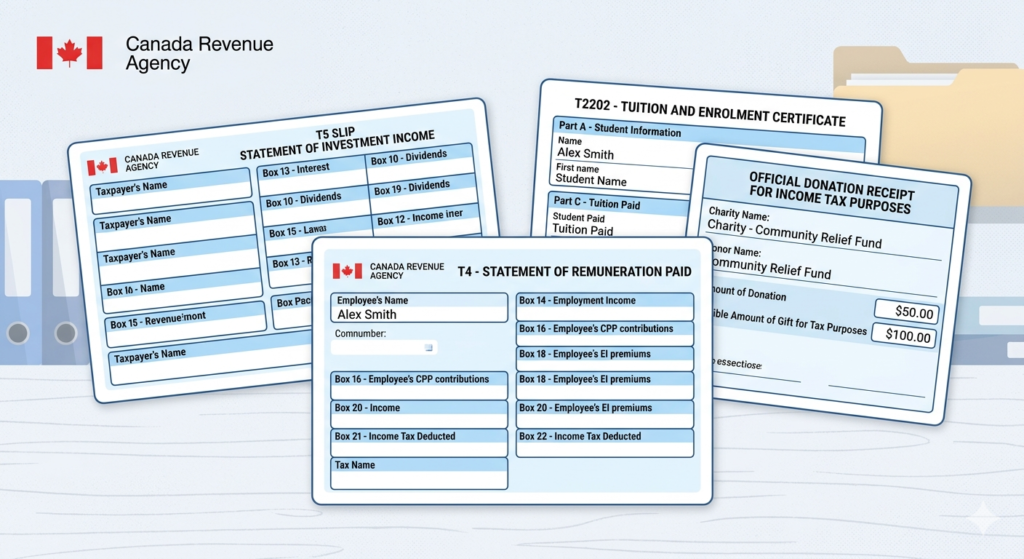
If you earn income from an employer, investments, or the government, you will receive “T-slips” outlining how much you made and how much tax was already withheld. Common slips include:
- T4: Statement of Remuneration Paid (for standard employment income).
- T4A: Statement of Pension, Retirement, Annuity, and Other Income (also used for some contractor or freelance payments).
- T4E: Statement of Employment Insurance and Other Benefits.
- T5, T3, and T5008: Slips reporting investment income, dividends, and securities transactions.
- T4FHSA: Statement for contributions and withdrawals from a First Home Savings Account.
3. Self-Employed and Small Business Records
If you run a business, freelance, or earn side-hustle income, you must complete Form T2125 (Statement of Business or Professional Activities). Since no one is withholding taxes for you, you need meticulous records of your earnings and business expenses:
- Income Records: Invoices you issued, sales receipts, and bank deposit records.
- Business Expenses: Receipts for advertising, software subscriptions, office supplies, and professional fees,.
- Home Office Expenses: If you work from home, calculate the square footage of your office relative to your home. Gather your utility bills, property taxes, home insurance, and rent receipts,.
- Vehicle Logbook: If you use your personal car for business, the Canada Revenue Agency (CRA) requires a detailed logbook tracking your total kilometers driven versus your business kilometers, alongside receipts for gas, maintenance, and insurance,.
4. Receipts for Tax Deductions and Credits
To lower your tax bill and maximize your refund, you need proof of your eligible expenses. Keep these receipts safely filed:
- RRSP Contributions: Receipts from your financial institution for contributions made during the 2025 calendar year, plus the first 60 days of 2026.
- Medical Expenses: Receipts for out-of-pocket healthcare costs not covered by insurance, such as prescription drugs, dental work, and vision care,.
- Charitable Donations: Official donation receipts featuring the charity’s registration number.
- Childcare Expenses: Receipts from daycares, camps, or tutors.
- Tuition (T2202): The Tuition and Enrollment Certificate issued by your post-secondary institution. If you are between 26 and 65, you may also use these eligible fees to claim the Canada Training Credit, provided you have a positive limit on your NOA.
- Real Estate Credits: If you bought your first home in 2025, you can claim the $10,000 First-Time Home Buyers’ Amount; keep your purchase agreement and closing documents on file. If you renovated a home to create a secondary unit for a senior or disabled relative, keep all construction receipts and permits to claim the Multigenerational Home Renovation Tax Credit (MHRTC),.
(Note: The Digital News Subscription Tax Credit officially ended in 2024 and is no longer available to claim for the 2025 tax year.)
5. Mark Your Calendar: 2025 Tax Year Deadlines
Missing a deadline can lead to immediate late-filing penalties and daily compound interest charges on any balance you owe,. Keep these 2026 dates in mind for your 2025 taxes:
Disclaimer: Even if you are self-employed and have until June 15 to file your return, any money you actually owe the CRA is still due on April 30,.