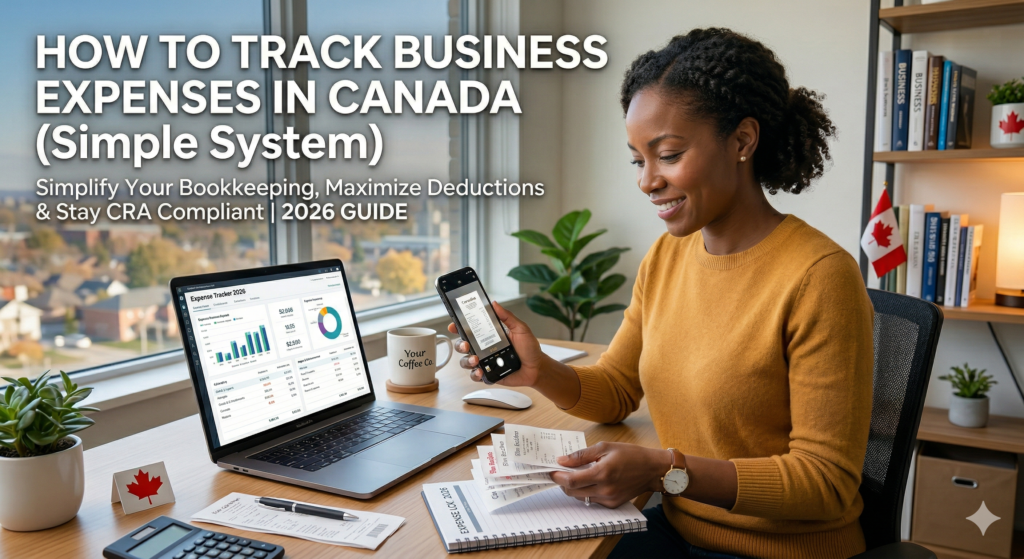
Tracking your business expenses shouldn’t feel like a part-time job. In Canada, staying on top of your books is the difference between a stressful tax season and a massive refund.
Managing your finances is one of the most important parts of running a business, yet it’s often the most neglected. If you wait until April to “find” your receipts, you’re likely leaving thousands of dollars on the table and risking a CRA audit.
Follow this simple system to automate your tracking and maximize your Canadian tax deductions.
Why You Need an Expense Tracking System
The Canada Revenue Agency (CRA) requires you to keep records of all your business transactions for six years plus the current tax year. Beyond compliance, a good system gives you:
- Real-time Cash Flow Insights: Know exactly where your money is going.
- Maximum Tax Savings: Ensure you claim every eligible cent (like that 50% meal deduction).
- Audit Protection: Digital logs provide a “paper trail” that the CRA respects.
The 3-Step “Simple System” for 2026
You don’t need a degree in accounting to manage your books. This workflow is designed to take less than 15 minutes a week.
1. Separate Your Finances Immediately
Never “co-mingle” your funds. Open a dedicated business bank account and a business credit card.
- Why? It makes your year-end reconciliation 100% easier because every transaction on that statement is automatically a business item.
2. Go Paperless with Digital Capture
The CRA now fully accepts digital versions of receipts as long as they are “an accurate reproduction.” Stop stuffing shoeboxes and use an app to snap a photo the moment you pay.
3. The “Monthly Triage”
Set a recurring calendar invite for the first Friday of every month.
- Review your digital folder or app.
- Match receipts to bank statements.
- Categorize them (e.g., Office Supplies, Travel, Professional Fees).
Common Canadian Business Deductions (2026 Update)
To track effectively, you need to know what to look for. Here are the most common categories for Canadian entrepreneurs:
| Expense Category | CRA Deduction Limit | Note |
| Meals & Entertainment | 50% | Only if you are discussing business. |
| Home Office | Proportional | Based on the square footage of your office vs. home. |
| Business Mileage | Proportional | You must keep a mileage log for the CRA. |
| Software/Tech | 100% | Includes your tracking software and AI tools. |
| Capital Assets | CCA Rates | Computers (Class 50) have a high depreciation rate (55%). |
Pro Tip: Calculating Home Office Expenses
If you work from home, you can deduct a portion of your rent, heat, electricity, and insurance. Use this simple calculation:
(Business Area ÷ Total Home Area) × Total Expenses = Your Tax Deduction
Example: If your office is 100 sq ft and your home is 1,000 sq ft (10%), and your total home bills are $10,000 for the year, you can deduct $1,000 as a business expense.
Top Tools for Tracking Expenses in Canada
Choosing the right tool is half the battle. Here are the top recommendations for 2026:
- Wave Accounting (Best for Freelancers): It’s free and specifically built for small Canadian businesses. It handles GST/HST beautifully.
- QuickBooks Online (Best for Growth): The gold standard for scaling. It integrates with almost every Canadian bank.
- FreshBooks (Best for Service Providers): Excellent for tracking billable hours and expenses simultaneously.
- Dext (Best for Receipt Management): A dedicated tool that “reads” your receipts and pushes the data into your accounting software.
The “6-Year Rule” and Digital Records
A common mistake is thinking you can toss receipts after you file. The CRA can ask to see your records from up to six years ago.
Note: If you use digital tracking software, ensure you have a cloud backup (like Google Drive or Dropbox) in case the software provider changes their terms or you close your account.
Final Thoughts
The “Simple System” isn’t about being an expert; it’s about consistency. By separating your accounts, capturing receipts digitally, and performing a monthly 15-minute review, you’ll be ahead of 90% of small business owners come tax time.
Ready to simplify your business? Start by opening that separate bank account today.